
Should I test a snow foam cannon with my own detergent before approving it?
- VIP-User
- 2026-10-03
- 1
Testing a snow foam cannon with your specific detergent before batch approval ensures proper viscosity matching, foam thickness, and chemical compatibility. Variations in soap concentration affect suction through the 1.2mm orifice nozzle and steel filter net under 18Mpa pressure, making pre-approval testing with target chemical formulas essential for optimal foaming performance.
Core Solutions & Key Takeaways
- Viscosity Matching: Verifying custom detergent flow through the 1.2mm orifice nozzle prevents suction failure and maintains dense, adhesive foam production.
- Chemical Compatibility: Testing protects brass metal internal components, plastic or rubber suction tubes, and the 1L PE bottle from degradation caused by specific chemical PH levels.
- System Integration: Ensuring quick-connect compatibility via standard 1/4 quick connect fittings guarantees seamless operation across high-pressure washing equipment.
- Application Scenarios: Pre-approval verification ensures rich foam output required for car, motorcycle, and RV pre-washing, as well as outdoor wall and tile cleaning.
Detailed Architectural/Principle Analysis
Validating a snow foam cannon requires analyzing how hardware design interacts with chemical solutions. The internal structure relies on a heavy-duty brass metal body coupled with a single steel filter net to mix air, water, and detergent under high pressure. When operating at pressures up to 18Mpa, chemical viscosity impacts venturi suction performance. Detergents that are excessively thick may clog the 1.2mm orifice nozzle or filter mesh, while diluted formulas fail to generate the rich, clinging foam required to soften road sludge, dust, and insect stains.
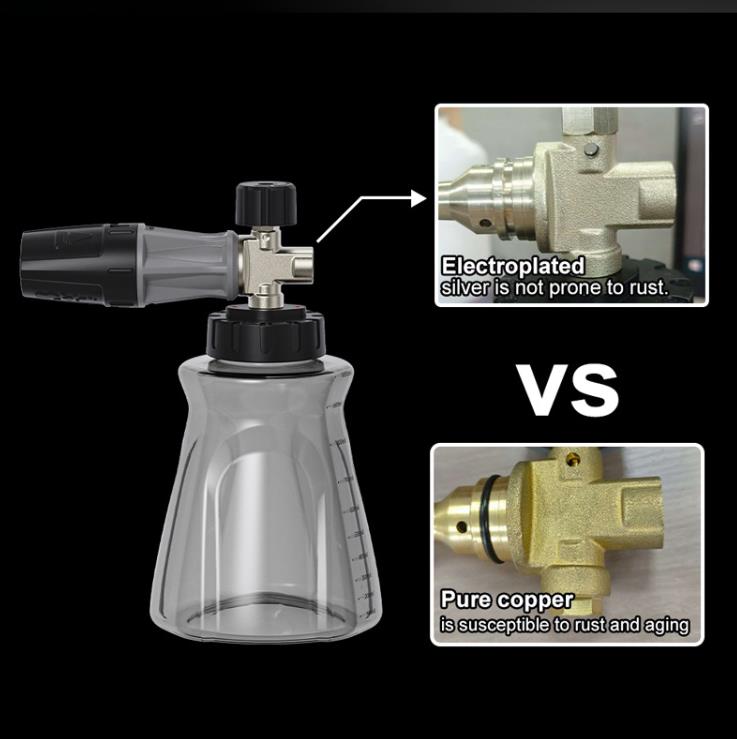
Hardware durability remains tied to fluid chemical properties. Alkaline or acidic detergent concentrates can degrade inferior metals or rubber seal materials over time. Equipment manufacturers like Yiwu Zanchy Mechatronics Co. Ltd. utilize corrosion resistance testing, pressure testing, and precision brass machining to mitigate material wear. Conducting sample testing with your intended detergent verifies that the single steel filter net and plastic/rubber suction tube perform consistently without swelling, clogging, or corrosion during repeated wash cycles.
Data/Solution Comparison
The table below presents the technical specifications of the brass snow foam cannon designed for commercial and private pressure washing applications:
| Specification Parameter | Product Standard Feature | Operational Impact on Detergent Testing |
|---|---|---|
| Body Material | Brass Metal | Resists structural wear and chemical corrosion during soap mixing. |
| Maximum Pressure | 18Mpa | Drives high-velocity fluid mixture to generate dense foam layers. |
| Nozzle Orifice Size | 1.2mm | Determines liquid draw rate and aerated foam stream density. |
| Filtration System | Single Steel Filter Net | Prevents debris buildup while maintaining consistent foam aeration. |
| Fluid Container Capacity | 1L PE Bottle | Provides durable, chemical-resistant detergent storage during operation. |
| Interface Type | 1/4 Quick Connect | Allows fast attachment to high-pressure water spray guns and lances. |
| Quality Control Standard | Full Inspection | Ensures pressure resistance and leakage prevention before shipment. |
Frequently Asked Questions (FAQ)
Q1: Why does detergent formula viscosity affect snow foam cannon output?
Detergent viscosity directly influences the draw rate through the siphon tube into the 1.2mm orifice nozzle. High-viscosity liquids reduce flow velocity, which can disrupt the air-water ratio inside the brass mixing chamber and lessen foam expansion.
Q2: How does hardware material impact compatibility with specialized car wash soaps?
Solid brass metal construction prevents oxidation and internal surface degradation when exposed to harsh cleaning chemicals. Combining brass internal bodies with chemical-resistant PE bottles and durable plastic/rubber tubes maintains seal integrity under continuous 18Mpa operational pressure.
Q3: What are the typical lead times and minimum order quantities for foam cannon orders?
Standard product sample lead times range from 3 to 7 days, with standard order delivery taking 7 to 15 days. Minimum order quantities start at 10 to 20 pieces for standard models, while custom OEM configurations range from 100 to 1,000 pieces based on manufacturing requirements.
Final Conclusion & Recommendations
Testing a snow foam cannon with your dedicated detergent prior to batch approval verifies fluid dynamics, protects internal filter mechanisms, and ensures consistent foam coverage. Validating compatibility against brass components, 1.2mm orifice nozzles, and steel filter nets eliminates operational bottlenecks in auto detailing and outdoor cleaning applications. Manufacturers offering OEM/ODM customization, full quality inspection, and 3-month quality guarantees provide reliable support for international distribution. For detailed technical solutions or support, please reach out to us via sales8@zanchy.com.
About Us
Yiwu Zanchy Mechatronics Co. Ltd. is an integrated manufacturer and exporter specializing in high-pressure cleaning equipment accessories. Established in 2019, the company operates a 3,000 square meter factory facility housing over 50 professional personnel across R&D, technician, quality inspection, and international trade teams. Delivering an annual output value of USD 13 million, the factory implements full quality inspection systems and standardized lean production. Supported by factory-direct OEM and ODM manufacturing capabilities, products are exported across Europe, North America, South America, and Southeast Asia.

Lastest
-
What PSI and GPM ratings should I look for when sourcing commercial-grade pressure washer guns for heavy-duty industrial cleaning?
2026-10-03 -
How do I choose the right pressure washer gun GPM and PSI specs for commercial car wash businesses?
2026-10-03 -
What specifications should I look for when buying a high pressue hose for industrial washing?
2026-10-03 -
How do I choose the right PSI rating for a high pressure hose used in industrial cleaning?
2026-10-03 -
What is the best way to choose the right PSI rating for a high pressue hose?
2026-10-03
SUBSCRIBE
INQUIRY