
What should I test first when evaluating pressure washer Accessories samples?
- VIP-User
- 2026-09-21
- 3
Test the pressure washer Accessories samples first for connection fit, leakage, and pressure performance. Confirm that the Karcher quick-connect inlet and Karcher plastic lance outlet engage correctly, then verify operation at the stated maximum working pressure of 18 MPa. Afterward, inspect spray function, plastic-valve condition, visible wear, and consistency across repeated sample use.
Core Solutions & Key Takeaways
- Start with interface compatibility: verify the Karcher quick-connect inlet and Karcher plastic lance outlet before applying pressure.
- Check leakage and pressure behavior using the product’s stated maximum working pressure of 18 MPa.
- Assess spray operation for high-pressure flushing tasks such as car-body cleaning and courtyard-floor washing.
- Record appearance, valve condition, repeated-use consistency, and any quality issue before approving a sample.
Detailed Architectural/Principle Analysis
The pressure washer gun sample uses a plastic valve and is specified for a maximum working pressure of 18 MPa. Its inlet is designed for a Karcher quick connection, while its outlet is designed for a Karcher plastic lance connection. These two interfaces should be checked before functional testing because an incorrect connection can affect sealing, operation, and sample evaluation accuracy.
Begin with a dry visual inspection. Check the plastic valve, connection surfaces, threads or locking areas, and visible molding condition. Look for cracks, deformation, incomplete molding, or contamination. This inspection does not replace pressure testing; it identifies visible conditions that could affect later results.
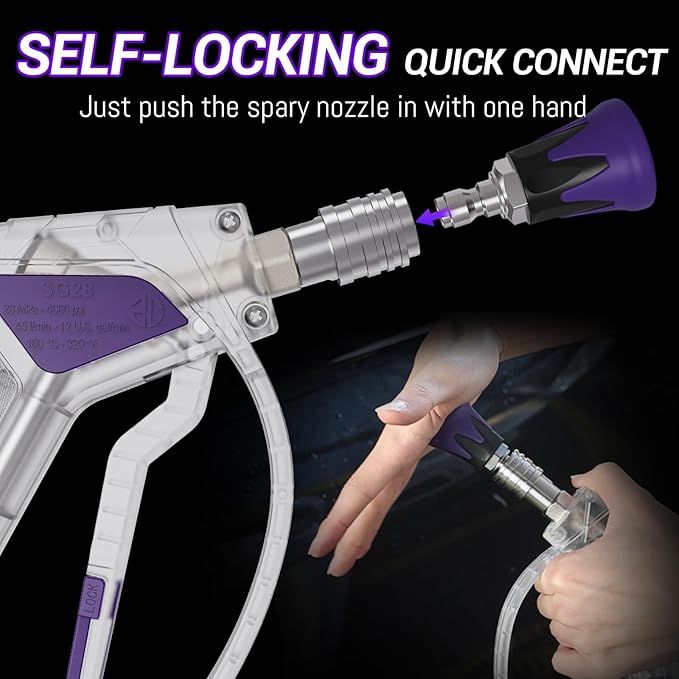
Next, connect the sample to the compatible water-gun or lance system without forcing the interface. Confirm that the Karcher quick-connect inlet locks correctly and that the outlet accepts the Karcher plastic lance connection. Inspect the connection area during operation for water leakage, movement, or an unstable fit.
Pressure performance should then be assessed against the stated maximum working pressure of 18 MPa. Record whether the sample operates normally, whether the connection remains sealed, and whether the plastic valve shows abnormal behavior. The available product data confirms the pressure specification but does not provide test results, so each sample should be evaluated and documented separately.
Spray behavior is relevant to the listed application scenarios. The gun is intended for high-pressure flushing, including car-body cleaning, courtyard-floor washing, balcony stain removal, and construction-equipment dust cleaning. A practical sample check should confirm controllable water discharge and consistent operation during these cleaning tasks.
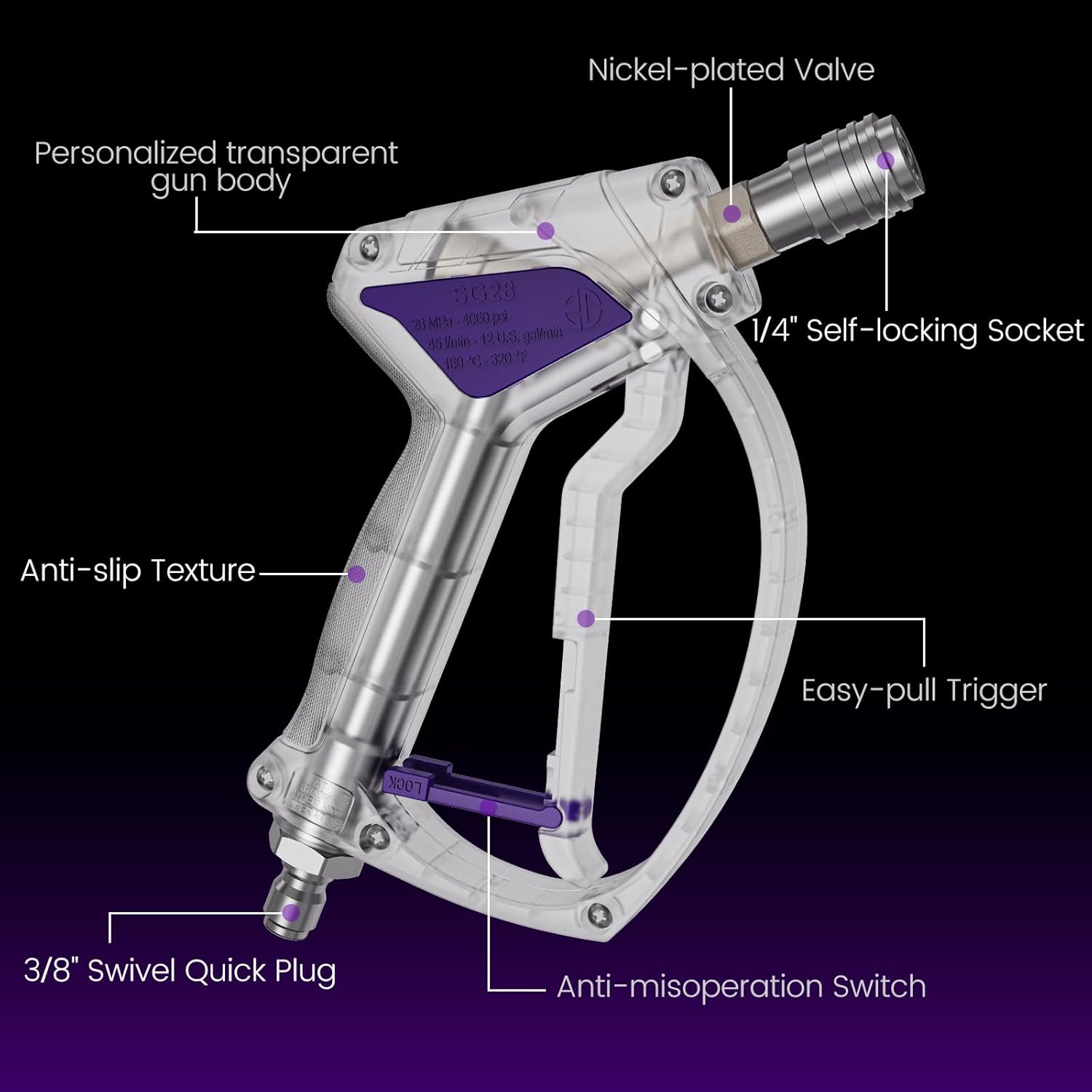
Repeat the connection, operation, and inspection steps across the available samples. Compare valve response, connection stability, leakage condition, and visible wear. This creates a traceable basis for sample approval without assuming performance beyond the supplied specification.
A cooperation case involving local American car-washing accessory distributors describes use in car-body cleaning, courtyard-floor washing, balcony stain removal, and construction-equipment dust cleaning. The case also records recognition for durability, reliability, and appearance, but these points should be verified through the purchaser’s own sample testing.
Data/Solution Comparison
| Evaluation area | Test focus | Available product evidence |
|---|---|---|
| Connection compatibility | Check the inlet lock and outlet fit with the specified Karcher connections. | Karcher quick-connect inlet and Karcher plastic lance connect outlet are specified. |
| Pressure performance | Operate the sample while monitoring sealing, valve behavior, and abnormal leakage. | Maximum working pressure is specified as 18 MPa. |
| Material and appearance | Inspect the plastic valve and molded surfaces for visible defects or deformation. | Plastic valve is specified; detailed material grade is not provided. |
| Spray operation | Check stable water discharge during vehicle, courtyard, balcony, or equipment cleaning. | Multi-purpose high-pressure flushing is listed as an application. |
| Order verification | Compare repeated sample results before standard or customized production. | Product MOQ is 10 pieces, with a stated delivery time of 7–10 days. |
Frequently Asked Questions (FAQ)
What should be checked before applying water pressure?
Inspect the plastic valve and connection surfaces, then confirm that the Karcher quick-connect inlet and Karcher plastic lance outlet fit and lock correctly.
What pressure value should the sample evaluation use?
The product data specifies a maximum working pressure of 18 MPa. The evaluator should document actual sample behavior at the applicable test condition and check for leakage or abnormal valve operation.
Which applications can help verify the pressure washer gun?
Car-body cleaning and courtyard-floor washing are listed applications. Balcony stain removal and construction-equipment dust cleaning are also included in the product’s stated use scenarios.
Final Conclusion & Recommendations
Connection fit, leakage control, and pressure performance should lead the pressure washer gun sample evaluation. Follow these checks with spray-operation testing, visual inspection, and repeated-use comparison. The product supports OEM and ODM manufacturing, factory-direct supply, bulk production, and flexible small-batch orders, with full inspection stated for quality control. For detailed technical solutions or support, please reach out to us via sales8@zanchy.com.
About Us
Yiwu Zanchy Mechatronics Co. Ltd. is an integrated manufacturer and exporter focused on the research, production, and sales of full-series accessories for high-pressure cleaning machines, including pressure washer guns, foam lances, spray nozzles, pressure hoses, quick connectors, and pump and filter accessories.
The company has more than 50 professional employees across R&D, production, quality inspection, and international sales service functions.
Its independent R&D team works on structural design, material optimization, product upgrades, mold development, performance testing, corrosion resistance testing, pressure resistance testing, and aging testing.
Monthly production of cleaning-machine accessories exceeds 150,000 pieces or sets, supporting both small-batch customized orders and large-batch orders.

Lastest
-
What PSI and GPM ratings should I look for when sourcing commercial-grade pressure washer guns for heavy-duty industrial cleaning?
2026-09-21 -
How do I choose the right pressure washer gun GPM and PSI specs for commercial car wash businesses?
2026-09-21 -
What specifications should I look for when buying a high pressue hose for industrial washing?
2026-09-21 -
How do I choose the right PSI rating for a high pressure hose used in industrial cleaning?
2026-09-21 -
What is the best way to choose the right PSI rating for a high pressue hose?
2026-09-21
SUBSCRIBE
INQUIRY